Limescale & Hard Water
How to Remove Limescale From a Shower Head Without Taking It Apart
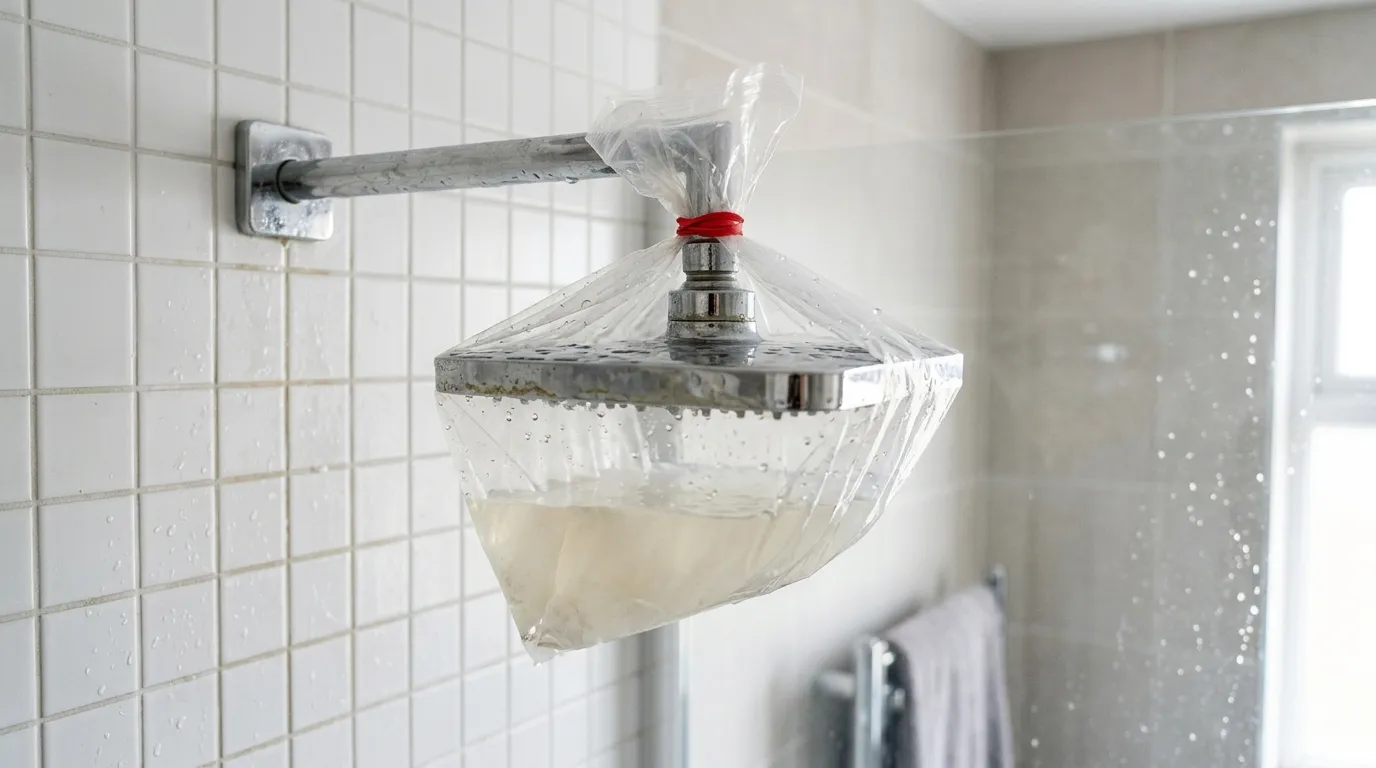
To remove limescale from a fixed shower head without unscrewing it, fill a strong sandwich bag with a descaling solution (two tablespoons of citric acid powder dissolved in about one litre of warm water, or white vinegar diluted 1:1), tie the bag over the head with an elastic band so the nozzles are submerged, and leave it to soak for around an hour. Then untie the bag, run the shower hot for a minute to flush out the loosened scale, and rub the nozzles with your finger or a soft brush. That clears the chalky white build-up that throttles your spray, and you never have to touch a spanner.
This works on the head exactly as it hangs on the wall, which matters for fixed rainfall heads, ceiling-mounted heads, and any unit you would rather not unthread for fear of stripping a seal or snapping a plastic thread.
Why your shower head furs up in the first place
Around 60% of the UK lives in a hard or very hard water area, mostly across the South East, East Anglia, the Midlands and parts of the South West where the supply runs over chalk and limestone. That rock dissolves calcium and magnesium into the water, and every time you run the shower hot, some of it precipitates out as solid calcium carbonate. The Drinking Water Inspectorate grades hardness in milligrams per litre of calcium carbonate (mg/l CaCO3): soft is up to 100, slightly hard is 100 to 150, moderately hard is 150 to 200, hard is 200 to 300, and anything above 300 counts as very hard. The harder your supply, the faster the nozzles crust over.
It is purely cosmetic and mechanical, not a health issue. The DWI sets no upper limit for hardness in drinking water, so hard water is safe to drink. The problem is the build-up: it blocks the spray holes, weakens the flow, throws the jets sideways and, left long enough, can choke the head entirely.
You can check your own hardness by asking your water company directly, since there is genuine local variation that area maps miss.
What you will need
- White vinegar, or citric acid powder (sold in most UK supermarket baking aisles and hardware shops)
- A strong food bag or freezer bag large enough to cover the head
- A sturdy elastic band, or a cable tie
- An old toothbrush or soft-bristled brush
- A cloth
Citric acid is the better choice if you have it. Which? recommends it over vinegar because it is a stronger descaler and does not leave a smell. Vinegar is fine for light scale and is the thing most people already have in the cupboard. Use plain white distilled vinegar, not malt or brown, which is weak and can stain.
The bag-soak method, step by step
- Mix your solution. For citric acid, dissolve two tablespoons of powder in roughly one litre of warm (not boiling) water. For vinegar, use it neat or diluted half and half with warm water.
- Fill the bag. Pour enough solution into the food bag to cover the spray plate when the bag is lifted up over the head.
- Bag the head. Slide the bag up and over the shower head so the nozzles sit fully under the liquid. Twist the bag’s neck and secure it tightly to the shower arm or hose with an elastic band so it cannot slip down.
- Leave it to soak. Around one hour clears typical scale. For thick, chalky build-up, leave it longer or overnight. Watch the timer if your head is plated (see the warning below).
- Remove and flush. Untie the bag, tip the solution into a bucket or the basin, and run the shower on hot for a minute or two to blast loosened scale out of the channels.
- Rub the nozzles. Most modern heads have soft rubber or silicone nozzles. Run a finger or thumb over them, or use a soft brush, to pop out the last flecks of softened scale. Give the spray plate a final wipe with a cloth.
If the flow is still patchy after one round, repeat the soak. Heavy scale that has been building for years sometimes needs two goes.
Soaking times by finish
The acid that eats limescale will also attack some decorative platings if you leave it on too long. Match the soak to your finish.
| Shower head finish | Maximum soak time | Notes |
|---|---|---|
| Standard chrome / chrome-plated plastic | Up to 1 hour, or overnight for heavy scale | The most common UK finish, tolerates acid well |
| Brushed or stainless steel | Up to 1 hour | Rinse thoroughly afterwards |
| Gold, brass or nickel-plated | 15 to 30 minutes maximum | Acid can dull or strip the coating; rinse at once |
| Coloured or matt-coated finishes | 15 to 30 minutes, test first | Check the manufacturer’s care guide before soaking |
When in doubt, do a short soak, check the result, and repeat rather than leaving a plated head submerged all night.
What not to do
- Do not use bleach. Research has found bleach can actually increase certain bacteria living inside shower heads. It also does little against limescale, which needs an acid.
- Never mix bleach with vinegar, citric acid or any acid. The reaction releases toxic chlorine gas. Pick one product and rinse it away before using anything else.
- Avoid harsh industrial descalers containing hydrochloric or formic acid on a plated head. They are aggressive enough to mark the finish.
- Skip wire brushes, scouring pads and pins. Metal tools scratch the spray plate and can permanently enlarge or distort the nozzle holes. A soft brush and a fingertip are all you need.
A note for electric showers
If you have an electric shower (the kind with a power unit on the wall that heats water on demand), the hand-held head and hose still descale exactly as above. The build-up inside an electric shower’s heater and the flow restrictor is a separate job and is better handled by the manufacturer’s own descaling guidance or a qualified engineer, because the internals are not designed to be soaked. For the head itself, the bag method is safe.
Keeping it scale-free
A quick weekly habit beats an annual deep clean. Once a week, rub a thumb over the rubber nozzles to knock off scale before it hardens, and give the head a wipe after your shower so water does not dry on the plate. Plan a full descale roughly once a month, and more often if you are in a hard or very hard area. If you are tired of fighting it across every tap, kettle and appliance in the house, a whole-home approach is worth reading about in our guide to softening hard water at home, and our best limescale removers for UK hard water areas compares the products worth keeping under the sink.
Frequently asked questions
How long should I leave vinegar on a shower head? About an hour for light to moderate scale, or overnight for thick build-up, if the head is standard chrome or steel. For gold, brass, nickel or coloured finishes, keep it to 15 to 30 minutes to protect the coating, then rinse well.
Is citric acid or vinegar better for descaling a shower head? Citric acid is the stronger descaler and leaves no smell, which is why Which? recommends it. Use two tablespoons of powder per litre of warm water. Vinegar works on lighter scale and is handy because most people already have it, but use plain white distilled vinegar rather than malt or brown.
Can I descale a shower head without taking it off the wall? Yes. Fill a food bag with descaling solution, tie it over the fixed head with an elastic band so the nozzles are submerged, and leave it to soak. This is the whole point of the bag method and it works on rainfall heads, ceiling heads and any unit you cannot easily unscrew.
Can hard water and limescale actually damage my shower? Yes, over time. Scale blocks the spray holes, weakens and skews the jets, and can eventually choke the head completely, as well as furring up the flow restrictor and internal channels. It is safe to drink, but it is hard on plumbing and appliances, which is why regular descaling pays off.
How often should I descale my shower head? Roughly once a month is a sensible baseline. In a hard or very hard water area you may need to do it more frequently, and a weekly thumb-rub over the nozzles keeps fresh scale from ever setting hard.
Can I use bleach to clean a shower head? No. Bleach does little against limescale and has been shown to increase certain bacteria inside shower heads. Critically, never mix it with vinegar or citric acid, because that produces toxic chlorine gas. Stick to an acid descaler for scale.